Region
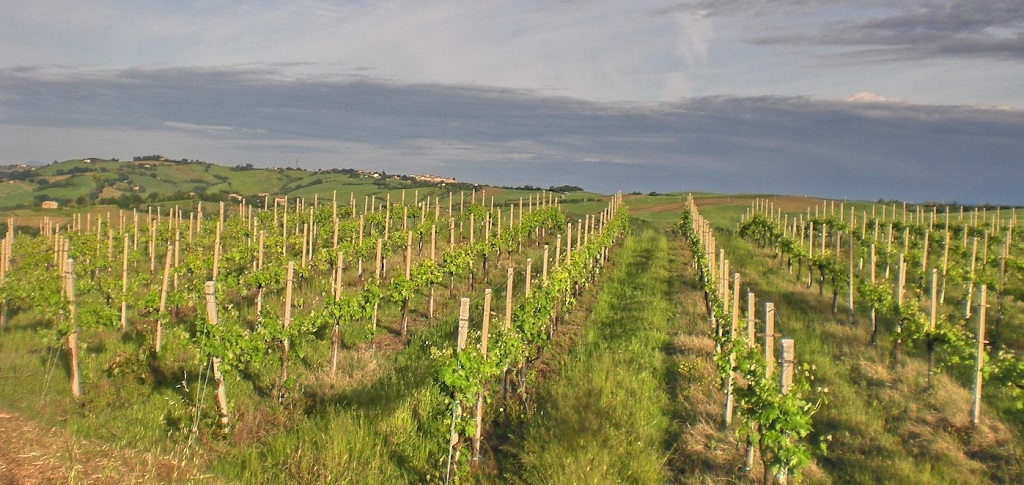
Le Marche is a relatively small wine region located to the east of central Italy. It is home to a number of excellent wines, notably from the white Verdicchio grape as well as from the red Sangiovese and Montepulciano.
2
31
Le Marche, nestled along the central Adriatic coast of Italy, is a region of gentle hills, medieval towns, and dramatic transitions between mountains and sea. Bordered by Emilia-Romagna to the north, Tuscany and Umbria to the west, and Abruzzo to the south, Marche sits quietly between more famous neighbors, often overlooked but deeply compelling. Its landscape is a rolling mosaic: the Apennines cut through the western interior, giving way to vineyard-covered hills and a ribbon of seaside plains along the Adriatic. Its towns—Urbino, Ascoli Piceno, Jesi, Loreto—are repositories of Renaissance art, religious pilgrimage, and rural tradition.
Culturally, Le Marche is understated yet rich. Its cuisine is rooted in the land and sea: porchetta and game meats from the hills, olive ascolane, seafood brodetto, and verdicchio-braised rabbit on the coast. The wines, too, reflect this balance between structure and freshness, mountain influence and maritime lift. Long associated with the crisp whites of Verdicchio, the region also produces distinctive reds from Montepulciano, Sangiovese, and native varieties like Lacrima and Pecorino. Le Marche may lack the global renown of Tuscany or Piedmont, but among those who seek authenticity, it offers some of Italy’s most honest, food-friendly, and terroir-driven wines.
Viticulture in Le Marche dates back to antiquity, with both Etruscan and Picene tribes cultivating vines before the arrival of the Romans. Roman texts praise wines from the region, and amphorae marked with regional origins have been found throughout the empire. Throughout the Middle Ages, wine remained integral to monastic and rural life, with clergy and noble estates maintaining vineyards for both sacramental and commercial use. The Renaissance brought artistic and agricultural flowering, especially in Urbino and Jesi, though winemaking remained largely localized and rustic, focused on field blends and tradition.
The 20th century marked a turning point. While much of Italy's central wine production turned toward modernization and appellation structure, Marche took a quieter path. In the 1960s and ’70s, pioneering producers like Umani Ronchi, Fazi Battaglia, and Bucci began refining Verdicchio into a serious white wine of depth and age-worthiness. This marked the beginning of the region’s quality renaissance. In recent decades, a new generation has pushed further: reducing yields, focusing on single vineyards, and reviving forgotten varieties like Pecorino and Passerina. Today, Marche’s wine culture combines ancient roots with a modern commitment to authenticity, biodiversity, and terroir expression, attracting growing attention from international critics and sommeliers.
Marche’s terroir is defined by its juxtaposition of mountain and sea, with vineyards cascading down from the eastern slopes of the Apennines toward the Adriatic coast. This topographical diversity creates a wide range of microclimates, where elevation, exposure, and distance from the sea dramatically affect style. Inland areas like Matelica and Offidaexperience greater diurnal temperature variation and cooler nights, yielding wines with higher acidity, precision, and mineral structure. Coastal zones, especially around Jesi and Conero, benefit from warmer days, sea breezes, and clay-limestone soils, which add body and ripeness to the wines.
The soils of Le Marche are typically calcareous clay, limestone, marl, and sandstone, interspersed with patches of gravel and silt in the lower valleys. These variations are essential to Verdicchio’s versatility: in Jesi, soils richer in clay yield fuller-bodied wines, while in Matelica, the higher elevations and rocky soils produce leaner, tenser styles. In the red wine zones, such as Conero and Rosso Piceno, Montepulciano thrives in iron-rich clay and loam, giving depth and density. Meanwhile, varieties like Pecorino, Passerina, and Ribona benefit from well-drained hillsides, where altitude and airflow preserve their aromatic profiles. Terroir in Marche is quietly powerful, shaping wines that are both age-worthy and intimately tied to place.
Marche is best known for Verdicchio, one of Italy’s greatest white grapes, producing wines of citrus, fennel, almond, and mineral character. It has remarkable aging potential and the ability to express subtle differences in soil and elevation. Verdicchio dei Castelli di Jesi is generally rounder and more fruit-driven, while Verdicchio di Matelica tends to be tighter, more linear, and slightly more austere. In recent years, producers have experimented with extended lees aging, concrete, and even skin contact, proving Verdicchio’s flexibility and seriousness.
Among white grapes, Pecorino—once nearly extinct—has surged back into prominence. Native to the Apennine foothills, it produces intense, aromatic wines with high acidity and saline minerality. Passerina, lighter and more floral, is often blended or vinified on its own in the southern provinces. Trebbiano Toscano and Malvasia appear in lesser roles, while Ribona (also called Maceratino) survives in Colli Maceratesi, yielding textured, herbal whites with good freshness.
For reds, Montepulciano is king, particularly in Conero and Rosso Piceno, where it is often blended with Sangiovese to create wines with both depth and brightness. Sangiovese can also stand alone in more delicate styles, especially in inland zones. Lacrima, a truly distinctive local grape, produces highly aromatic, violet-scented reds with a soft, juicy profile, most famously in Morro d’Alba. These grape varieties, both noble and eccentric, contribute to Marche’s growing reputation for producing wines that are distinctive, expressive, and deeply regional.
Le Marche is home to five DOCGs and over fifteen DOCs, a high number for a relatively small region, reflecting the varied microclimates and strong local identities. The most famous and important DOCG is Verdicchio dei Castelli di Jesi Riserva DOCG, which covers the historic heartland of Verdicchio production near Jesi. Its twin, Verdicchio di Matelica Riserva DOCG, lies inland at higher altitudes in the Esino valley, producing more structured and mineral-driven styles. These DOCGs sit atop broader DOCs—Castelli di Jesi Verdicchio DOC and Verdicchio di Matelica DOC—which allow for a wide range of dry, sparkling, and sweet expressions.
On the red wine front, the Conero DOCG (previously Rosso Conero Riserva DOCG) near the coastal Mount Conero focuses on Montepulciano-based wines, often blended with Sangiovese, known for power, deep fruit, and a hint of maritime salinity. Further south, Offida DOCG has become a hub for quality whites from Pecorino and Passerina, as well as structured reds from Montepulciano. Other notable DOCs include Rosso Piceno DOC, which spans a large area and produces approachable blends of Montepulciano and Sangiovese; Lacrima di Morro d’Alba DOC, for highly aromatic reds made from the unique Lacrima grape; and Colli Maceratesi DOC, which allows for both red and white styles and includes the little-known Ribona grape.
The most defining trend in Marche today is the rediscovery and elevation of native grape varieties, driven by a younger generation of winemakers committed to terroir and sustainability. Producers are refining their approach to Verdicchio, not only through site-specific bottlings and low-intervention techniques, but also by embracing extended lees aging, wild fermentation, and low sulfur use. The result is a new wave of Verdicchios that combine classic freshness with complexity, texture, and aging potential that rivals top white Burgundy. Single-vineyard expressions, once rare, are now increasingly common, especially among top producers in Castelli di Jesi and Matelica.
Simultaneously, red wine production is maturing. Montepulciano-based wines are being made with greater finesse and restraint, moving away from excessive extraction and oak toward transparency and balance. Lacrima, once seen as quirky or overly aromatic, is finding new life in drier, more structured forms that retain the grape’s wild character while gaining broader appeal. Across the region, there is a strong move toward organic and biodynamic farming, lower yields, and vineyard revitalization, especially in inland zones like Offida and Colli Maceratesi. Marche’s producers are united by a desire to prove that this overlooked region can offer wines that are elegant, authentic, and age-worthy, without abandoning its agrarian soul.