Appellation
Established in 1995, St. Helena is an American Viticultural Area contained entirely within the word famous Napa Valley appellation. It is known for producing red wines principally from the Cabernet Sauvignon grape, and ranks amongst its wineries some of California’s most famous names.
1
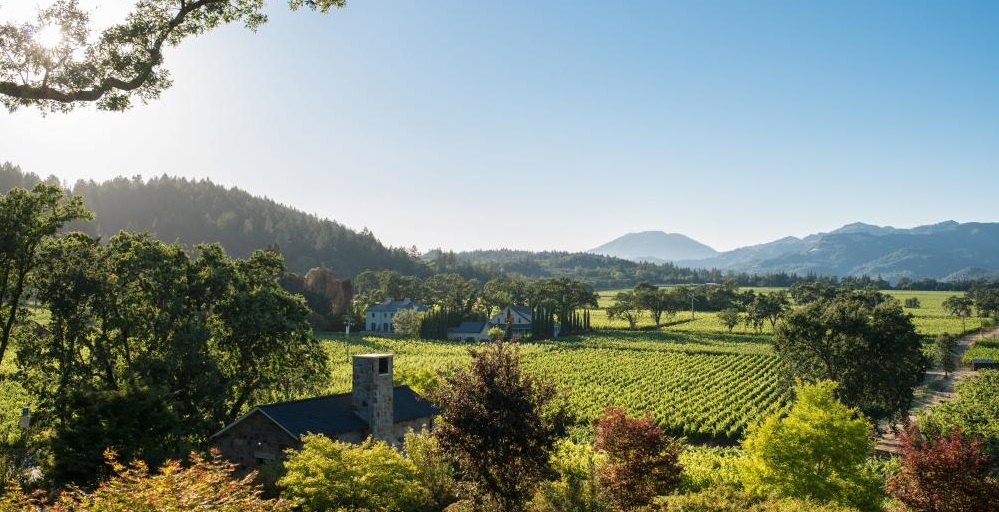
Situated at the narrow end of Northern California’s Napa Valley and centred around the town which shares its name, St. Helena AVA covers a geographic area a little over four-thousand-five-hundred hectares, of which two-thousand-eight-hundred are planted to vine. It is often heralded as the birthplace of Napa’s commercial wine industry and has been associated with high quality viticulture since the first wine grapes were planted here in around 1860. Owing to its location in the bottleneck of the valley between the Vaca and Mayacama ranges, St. Helena experiences a warm, Mediterranean climate with heat reflected by the mountains on both sides. In summer, daytime temperatures can approach one-hundred degrees Fahrenheit (thirty-eight degrees Celsius) making it one of the valley's warmest appellations, and the area also benefits from significant diurnal temperature variation. Hence, Bordeaux varieties have been found to thrive here, producing wines which are typically deep in colour with an abundance of ripe fruits flavours, good tannic structure and the ability to age well. In addition to the Cabernet Sauvignon and Merlot varietals for which it receives most acclaim, St. Helena’s winemakers have also found significant success in producing rich, dark Zinfandel and fleshy, mildly earthy Syrah wines. Of the white wines made here, crisp, fresh Sauvignon Blanc with plenty of passion fruit flavour is perhaps the most widely produced, along with a little of the Californian omnipresent Chardonnay. Unlike neighbouring Calistoga whose soils are fairly uniform, St. Helena’s vines are planted in a variety of different soil types ranging from free draining gravel to deep, fertile loam. Indeed multiple soil types may be found within an individual plot! This diversity is also replicated in the variety of topography, elevation and aspect within the region. Today, St. Helena has more than four-hundred vineyards, eighty plus wineries and an established reputation for excellence. Many of the appellation’s wineries are well known internationally such as Beringer, Joseph Phelps, Charles Krug and Turley Wine Cellars, whilst others are small, bespoke operations. With the continued trend towards wine tourism, tasting rooms and winery tours are also very much part and parcel of the package here.
St. Helena AVA, located in the northern part of Napa Valley, has deep viticultural roots dating back to the mid-19th century. Pioneering winemakers such as Charles Krug and Henry Pellet planted some of the region’s first vineyards in the 1860s, helping to establish Napa Valley as a premier wine-growing region. By the late 19th century, St. Helena had become a thriving center for viticulture and winemaking, with several key wineries laying the foundation for Napa’s modern success. Despite setbacks such as Prohibition, the region rebounded strongly and was officially designated as an American Viticultural Area (AVA) in 1995. Today, St. Helena AVA is home to some of Napa’s most prestigious estates, recognized for its structured, age-worthy wines
The AVA is best known for powerful yet polished Cabernet Sauvignon, which showcases flavors of blackcurrant, dark cherry, espresso, and spice, often with structured tannins that soften beautifully over time. Merlot and Cabernet Francblends bring additional layers of complexity, while Zinfandel offers a bold, fruit-forward alternative. White wines from Sauvignon Blanc and Chardonnay tend to be rich and expressive, with a balance of acidity and texture.
St. Helena AVA is particularly known for its Cabernet Sauvignon, which thrives in the warm climate and well-drained soils. Other Bordeaux varieties such as Merlot, Cabernet Franc, and Petit Verdot are widely planted, often used in blends to enhance complexity. Zinfandel, a grape historically significant to California, also performs well here, producing bold, ripe wines with rich berry flavors. While red varieties dominate, some Chardonnay and Sauvignon Blanc are grown in cooler pockets, offering vibrant expressions of these white grapes.
The region has seen a shift toward precision viticulture, with winemakers emphasizing small-lot, site-specific expressions of Cabernet Sauvignon and Bordeaux-style blends. Sustainability and organic farming are increasingly prioritized, with many estates converting to certified organic and biodynamic practices. There is also a growing focus on elegance over power, with some producers refining their winemaking techniques to emphasize balance and freshness rather than excessive ripeness and extraction.