Region
Emilia Romagna's wines often suffer from a lack of hype, nevertheless there are lots of small appellations worth looking at.
3
34
Emilia–Romagna stretches gracefully across northern Italy, from the Apennine Mountains in the south to the Po Riverplain in the north, and from the Ligurian border in the west to the Adriatic Sea in the east. It is a large, fertile, and economically vital region—historically a crossroads of trade, language, and culture. Geographically and culturally, it comprises two distinct halves: Emilia, running from Piacenza to Bologna, is known for its industrious spirit and deep gastronomic traditions; while Romagna, east of Bologna toward Rimini and Ravenna, is warmer, flatter, and more rural, with strong local pride and a distinct dialect. Together, the region forms a diverse and abundant heartland—Italy’s pantry and one of its most essential culinary destinations.
Food and wine are inseparable here. Emilia–Romagna is the birthplace of Parmigiano-Reggiano, Prosciutto di Parma, Modena balsamic vinegar, tortellini, and ragù alla Bolognese. Its cuisine is hearty and precise, born from centuries of agricultural prosperity and regional craftsmanship. The wines of Emilia–Romagna are deeply tied to the table: refreshing, food-friendly, and often slightly sparkling. From the frothy reds of Lambrusco to the saline whites of Albana and Trebbiano Romagnolo, the region produces a stylistic diversity reflective of its cultural richness. Long underestimated, Emilia–Romagna is now gaining recognition for both its historical depth and its modern drive toward quality.
Viticulture in Emilia–Romagna predates the Romans, with evidence of Etruscan vine cultivation in the hills near modern-day Bologna and Piacenza. Under Roman rule, the region became an important viticultural center, supplying wines to the legions and cities of the expanding empire. During the Middle Ages, monasteries and aristocratic estates refined vineyard practices, and by the Renaissance, wines from areas like Modena, Faenza, and Castelvetro were esteemed for their vibrancy and drinkability. The Lambrusco grape, in particular, has been associated with Emilia since antiquity, valued for its high yield and naturally fizzy character.
In the 20th century, the region's reputation suffered somewhat due to mass production, especially of sweet, industrial Lambrusco exported in large volumes. However, beginning in the 1990s, a quiet revolution took root: producers began emphasizing drier styles, old-vine selections, and ancestral methods of sparkling winemaking. In Romagna, a parallel revival was underway for native grapes like Sangiovese di Romagna and Albana, as winemakers explored terroir-specific expressions and modernized cellar techniques. Today, Emilia–Romagna’s wine scene reflects both its historical breadth and contemporary dynamism: a region where rustic tradition and modern elegance coexist, often in the same glass.
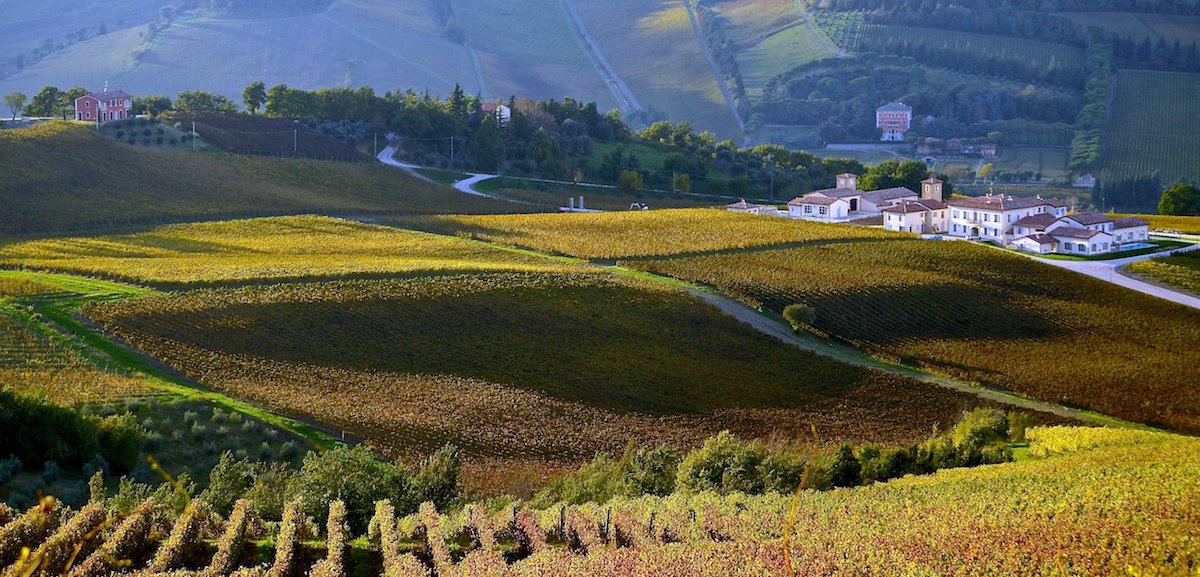
Emilia–Romagna’s terroir is remarkably varied, transitioning from alpine foothills and rolling uplands in the south to fertile plains and river valleys in the north. The Apennine slopes, which stretch from Piacenza in the west through Bologna and into Romagna, offer elevations between 200 and 600 meters, with soils composed of limestone, clay, marl, and sandstone. These hillside sites are ideal for structured reds like Sangiovese and Barbera, as well as aromatic whites such as Malvasia and Albana. The cooler night temperatures and sun-exposed slopes lend wines balance, freshness, and aromatic lift.
North of the hills, the Po Valley opens up into a vast, flat plain, rich in alluvial soils, silts, and loams—perfect for high-yielding varieties and wines meant for early drinking. It is here that most Lambrusco is produced, benefiting from the humid, temperate climate and fertile terrain. In contrast, zones like Colli Piacentini and Predappio are increasingly prized for their elevation, drainage, and old-vine plantings, which enable more nuanced and age-worthy wines. Along the eastern edge, near the Adriatic, sandy and calcareous soils support crisp, saline whites and contribute to the lightness and approachability of the region’s more coastal wines. The interplay of hills, plains, and sea breezes helps define Emilia–Romagna’s broad stylistic range.
Emilia–Romagna is home to a wide array of native and local grape varieties, many of which are found almost nowhere else. The Lambrusco family dominates in Emilia, with key varieties including Lambrusco di Sorbara, prized for its floral notes and acidity; Lambrusco Grasparossa, darker and more tannic; and Lambrusco Salamino, the most widely planted. These grapes yield wines that are lively, refreshing, and increasingly vinified in dry styles with serious food-pairing potential. In Piacenza, Barbera and Croatina (also known as Bonarda) form the base of Gutturnio, a deeply colored red that can be both rustic or refined. Ortrugo, an ancient white grape, is used for frizzante and still wines with delicate orchard fruit and herbal tones.
In Romagna, Sangiovese is the most important red grape, covering a spectrum from light and spicy to bold and structured, especially when grown in hillside zones with lower yields. Albana, once dismissed as oxidized or overly sweet, is now seeing a renaissance in both dry and passito styles, showing floral, apricot, and almond notes with excellent aging potential. Trebbiano Romagnolo, though widespread, is often neutral and high-yielding, though some producers are exploring older clones and low-intervention methods to recover its character. Other traditional grapes include Malvasia di Candia Aromatica, Montù, and Negretto, along with an increasing presence of international varieties like Cabernet Sauvignon, Merlot, and Chardonnay, particularly in flatter, more commercial zones.
Emilia–Romagna contains a wide array of DOCs and DOCGs, reflecting its size and varietal diversity. The most iconic is Lambrusco, a family of related grape varieties and appellations concentrated in the province of Modena and Reggio Emilia. Key denominations include Lambrusco di Sorbara DOC, known for its light color and bright acidity; Lambrusco Grasparossa di Castelvetro DOC, the darkest and most structured; and Lambrusco Salamino di Santa Croce DOC, which offers balance and fruitiness. These wines are typically made frizzante (semi-sparkling), and increasingly in dry or off-dry styles, though sweeter examples remain popular both locally and abroad.
In Romagna, the main DOC is Romagna DOC, a large and flexible denomination that includes subzones for Sangiovese, Albana, and Trebbiano Romagnolo. The region’s standout white is Albana di Romagna DOCG, Italy’s first white wine to receive DOCG status (in 1987), known for both dry and passito (dessert) styles. Sangiovese di Romagna, once dismissed as rustic, is now undergoing a transformation, especially in hillside zones like Predappio and Brisighella, where terroir-driven expressions with finesse and structure are emerging. Other noteworthy DOCs include Colli Piacentini DOC, in the far west near Lombardy, where Barbera, Bonarda, Ortrugo, and Malvasia di Candia Aromatica are prominent; Gutturnio DOC, which blends Barbera and Croatina into robust reds and frizzante styles; and Colli Bolognesi DOC, home to Pignoletto, a crisp, lightly sparkling white increasingly bottled under the DOCG Pignoletto dei Colli Bolognesi label.
The most exciting trend in Emilia–Romagna is the reclamation of quality and authenticity across both Emilia and Romagna. In the west, producers of Lambrusco are redefining the wine’s image by returning to dry, traditional, and bottle-fermented methods (metodo ancestrale), crafting wines that are complex, savory, and gastronomic. These “new wave” Lambruschi have gained traction among sommeliers and export markets, shaking off the stigma of sugary supermarket fizz. Simultaneously, old clones are being revived, vineyard work has become more meticulous, and a new generation of growers is embracing organic farming and low-intervention winemaking.
In Romagna, Sangiovese is enjoying a renaissance, with increased emphasis on cru designations, vineyard mapping, and terroir transparency. Subzones like Predappio, Brisighella, and Modigliana are producing some of Italy’s most exciting new expressions of Sangiovese—wines with structure, mineral drive, and aging potential. Albana, too, is being reassessed, with producers exploring lees aging, amphora, and oxidative techniques to showcase its potential. Across the region, there is growing interest in autochthonous varieties, natural wines, and the reclamation of underappreciated zones like Colli Piacentini and Colli Bolognesi. Emilia–Romagna, once defined by quantity, is now quietly positioning itself as a center of regional diversity, artisanal revival, and food-friendly wine production—the liquid extension of Italy’s most generous table.