Region
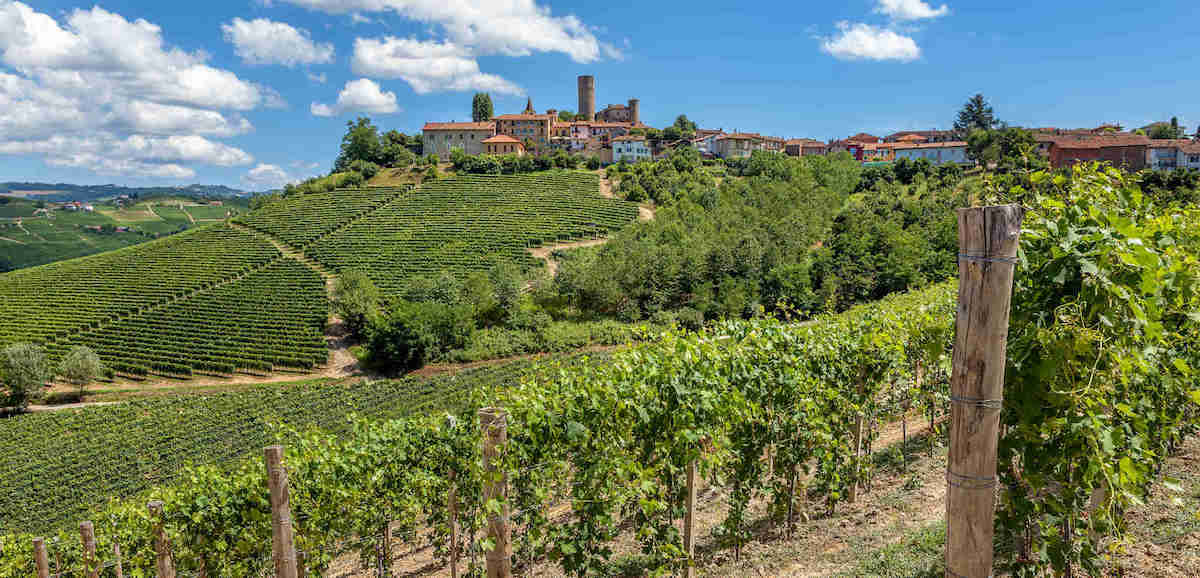
Piedmont stands out as one of the world's great wine regions. Home to legendary villages such as Barolo and Barbaresco, but also other exciting Nebbiolo based wines from Ghemme and Gattinara. Great whites come from Gavi, while sweet Moscato from Asti is making a comeback.
61 (showing 20)
270 (showing 200)
Piedmont—or Piemonte, meaning “foot of the mountains”—lies in Italy’s northwest, bordered by France to the westand Switzerland to the north, with the Alps encircling much of its landscape and casting a long, protective shadow over its vineyards. The region’s heart beats in the rolling hills of the Langhe, Roero, and Monferrato, UNESCO World Heritage landscapes that are as culturally rich as they are agriculturally revered. Turin, the capital, offers baroque grandeur and a deep-rooted gastronomic tradition, while smaller towns like Alba, Asti, and Bra embody a slower, more rural rhythm. This is the home of white truffles, hazelnuts, tajarin pasta, and bagna cauda—all of which find natural companions in the region’s noble, complex wines.
Piedmont is defined by a climate of quiet intensity: long, cold winters and foggy autumns shape not only the growing season but the character of the people and their wines. The region is often called the Burgundy of Italy, not only because of its devotion to site expression and small-scale growers, but because its wines—especially those made from Nebbiolo—demand patience, intellect, and nuance. Yet Piedmont is not only serious reds: it is also the land of joyous sparkling wines, crisp aromatic whites, and distinctive indigenous grapes. It is, above all, a region of strong traditions and careful evolution, where the relationship between land and vine is treated with reverence.
Viticulture in Piedmont dates back to pre-Roman times, with evidence that the Ligurians and Celts cultivated vines in the region before Roman occupation. The Romans expanded and systematized winemaking, and throughout the Middle Ages, monastic orders and feudal lords maintained vineyards, particularly in the Langhe and Monferrato. Piedmont’s proximity to France and its relative isolation from central Italian power structures gave it a distinct viticultural path. By the 18th and 19th centuries, with the rise of the House of Savoy and a blossoming of Enlightenment thinking, Piedmont became a hub of wine research and experimentation.
In the mid-19th century, winemakers like Camillo Benso, Count of Cavour, worked with French oenologists to tame the structure of Nebbiolo into a wine that could rival Bordeaux, what we now know as Barolo. The 20th century brought waves of change: phylloxera, wars, and post-war economic struggles were followed by a modern quality revolution in the 1980s and ’90s. The “Barolo wars” between modernists and traditionalists highlighted a philosophical divide over oak, maceration times, and vineyard identity, but ultimately deepened the region’s global reputation. Today, Piedmont stands as one of the world’s greatest wine regions, known for its depth of tradition, passionate producers, and clarity of expression.
Piedmont’s terroir is fundamentally hilly, continental, and stratified, with most fine wine production occurring at elevations between 200 and 500 meters. The Langhe and Roero areas are defined by calcareous marl, sandstone, and clay-rich soils, which vary dramatically from one hillside to the next. In Barolo, the western communes such as La Morra and Barolo have younger Tortonian soils, which produce softer, more fragrant Nebbiolo, while the eastern communes like Serralunga d’Alba and Monforte d’Alba feature older Helvetian sandstone, resulting in firmer, more tannic wines.
Barbaresco, slightly lower in elevation and closer to the river, ripens earlier and has soils that are predominantly Tortonian marl, giving more elegance and polish to its Nebbiolo. Roero, on the north bank of the Tanaro, is sandier, with a lighter structure and more aromatic lift, especially in Arneis. The Monferrato hills, farther east, are warmer and more rounded, with a mix of marl, clay, and silt, ideal for Barbera and Grignolino, while the Alto Piemonte, further north, combines volcanic soils and glacial deposits, offering ethereal, mineral Nebbiolos in appellations like Gattinara DOCG and Ghemme DOCG.
High elevation plays a crucial role in Alta Langa, where sparkling wine production benefits from cool nights and well-drained, calcareous soils. The diversity of soils, exposures, and microclimates, combined with Piedmont’s extreme attention to site-specific winemaking, makes terroir not just important, but defining in nearly every wine produced here.
Nebbiolo is the unquestioned king of Piedmont, and one of the world’s most noble red grapes. Late-ripening and transparent to site, it produces wines of rose, tar, cherry, licorice, and truffle, with high acidity and firm tannins that demand age. Nebbiolo is used not only in Barolo and Barbaresco, but also in Gattinara, Ghemme, Roero, and Nebbiolo d’Alba, each expressing a different facet of its character. Though planted outside Piedmont, nowhere else does Nebbiolo achieve such complexity and emotional resonance.
Barbera is the region’s most widely planted grape and the everyday wine of many locals. It is generous, high in acidity, and low in tannin, producing wines of vivid red fruit, spice, and food-friendliness. The best come from Asti, Alba, and Nizza, where producers are exploring barrel aging and site specificity. Dolcetto, darker and softer, offers easy-drinking charm with notes of blackberry, almond, and bitter herbs, especially in Dogliani and Ovada. Lesser-known reds include Freisa, a peppery, sometimes sparkling cousin of Nebbiolo; Grignolino, pale, spicy, and tannic; and Pelaverga, a quirky, light-bodied red with strawberry and white pepper notes.
On the white side, Arneis leads the charge, especially in Roero, producing floral, slightly nutty wines with freshness and texture. Cortese, grown in Gavi, is leaner and more mineral, while Favorita (related to Vermentino) and Erbaluce add further diversity. For sparkling, Chardonnay and Pinot Nero dominate in Alta Langa, yielding serious metodo classico wines. Though red wine dominates Piedmont’s identity, its whites and sparkling wines are increasingly recognized for precision, character, and versatility.
Piedmont is one of the few major Italian regions that has chosen not to operate an IGT tier at all, relying instead on an unusually dense and confident framework of DOC and DOCG classifications. The region includes a large number of DOCs and DOCGs, from Barolo and Barbaresco to Barbera d’Asti, Barbera del Monferrato Superiore, Asti, Gavi, Roero and Dogliani, each with clearly defined rules governing grape varieties, yields, ageing and labelling. When wines fall outside those rules, whether through experimentation, climatic damage, or stylistic choice, they are typically released simply as Vino rather than through an intermediate classification. MGAs, or Menzioni Geografiche Aggiuntive, sit alongside this system rather than beneath it. They are not a quality designation or a classification level but a legally defined set of named vineyard areas within Barolo and Barbaresco, designed to add geographical precision without altering production rules or hierarchy. Together, the absence of an IGT and the presence of MGAs underline Piedmont’s preference for depth, discipline and internal refinement over flexibility or symbolic rebellion.
Piedmont is home to the highest number of DOCGs in Italy, a testament to its diversity and depth. The two flagship appellations are Barolo DOCG and Barbaresco DOCG, both made entirely from Nebbiolo and located in the Langhe hills south of Alba. Barolo is more powerful and long-lived, often requiring a decade or more to unfold, while Barbaresco, though still structured, tends to be more approachable in youth and slightly more elegant. Both are subdivided into crus, or MGA (Menzione Geografica Aggiuntiva), that reflect specific terroirs, similar to Burgundy’s climats.
The Roero DOCG, on the north bank of the Tanaro River, produces Nebbiolo as well, in a lighter, more perfumed style, alongside the compelling white wine Roero Arneis DOCG. In the Monferrato hills, Barbera d’Asti DOCG and Barbera del Monferrato Superiore DOCG focus on Barbera, a vibrant red with acidity and depth, while Nizza DOCG (once a subzone) is now a stand alone denomination making a claim for the most prestigious expressions of Barbera. The Dolcetto grape finds its most important DOCG expression in Dogliani, and to a lesser extent in Ovada, where it yields darker, soft reds with bright fruit and a gentle bitterness.
For whites, Gavi DOCG, made from Cortese, is the most internationally recognised, offering fresh, mineral wines that are usually very well priced. Alta Langa DOCG has emerged as Piedmont’s answer to Franciacorta, producing traditional method sparkling wines from Chardonnay and Pinot Noir at higher altitudes. There are other DOCs of importance too: Langhe DOC, Monferrato DOC, Nebbiolo d’Alba DOC, Dolcetto d’Alba DOC, Freisa d’Asti DOC, among others. They typically provide flexibility for innovation and younger vines.
Piedmont’s wine scene is marked by a mature confidence and deepening of identity. The once-heated debates between modernists and traditionalists in Barolo have softened into a middle ground, where many producers now blend modern hygiene with traditional maceration and aging practices. There is a growing focus on cru-specific bottlings, and an increased interest in highlighting the individual personality of vineyards, especially as climate change alters ripening patterns and pushes some growers to higher elevations.
Elsewhere, there is renewed energy around lesser-known native grapes. Pelaverga, Grignolino, and Freisa are being reimagined not as curiosities but as serious expressions of place, often made with low intervention and organic farming. In Alta Langa, more producers are betting on sparkling wine, seeing it not as an imitation of Champagne but as a distinctly Piedmontese expression of freshness and refinement. Sustainability, organic viticulture, and climate resilienceare now central conversations, especially in areas where Nebbiolo’s balance is sensitive to heat and drought.
Finally, Piedmont continues to lead Italy in global prestige not only because of Barolo and Barbaresco, but because of its commitment to site, subtlety, and soul. In a world saturated with bold flavors and homogenous wines, Piedmont remains a beacon for those who seek quiet power, aromatic complexity, and a deep connection to the land.
Barolo and Barbaresco are the unavoidable starting points for Piedmont, not only because of their fame but because they establish the region’s core values of structure, tannin and patience. They show Nebbiolo at its most demanding and most complete, and even in more accessible examples they set the intellectual framework for understanding the region. Beyond them, Roero can sometimes offer a good alternative, with Nebbiolo grown on sandier soils producing wines that are more aromatic and earlier drinking while retaining clarity and regional identity. Dogliani is worth seeking out for Dolcetto that defies its reputation for simplicity, delivering depth, tension and a seriousness that often comes as a surprise. In the north, Ghemme and Gattinara provide a cooler, more linear expression of Nebbiolo shaped by altitude and volcanic influence, favouring precision over power and rewarding time in bottle. Among the whites, Timorasso from the Colli Tortonesi stands out as one of Italy’s most compelling expressions, structured and textural with an ability to age that challenges assumptions about Italian white wine. Nascetta, particularly from the Langhe, offers a quieter but equally instructive alternative, herbal and restrained, increasingly valued for its sensitivity to site. Freisa deserves renewed attention in its drier, more disciplined forms, where freshness, light tannin and spice come together in a distinctly local voice. Pelaverga, especially from Verduno, shows Piedmont at its most delicate and aromatic, pale in colour and lifted in character, reminding the drinker that the region’s identity is not built on power alone but on range, nuance and restraint.

Gianni Doglia · 2022
Tenuta Garetto · 2021